Professional Clarity in Times of Uncertainty: How to Position Yourself When the Path Is Not Clear in 6 Steps
The Quiet Transition Many Professionals Are Facing When it Comes to Professional Clarity in Times of Uncertainty
There is a transition happening in the professional world that is rarely spoken about openly….And that is professional clarity in times of uncertainty.
Some individuals are moving out of corporate environments to build something of their own, while others remain within corporate structures but feel a growing sense of misalignment. It can be seen as a subtle disconnect between their work and their internal direction.
Although these situations appear different on the surface, they often share the same underlying experience:
A lack of clarity, positioning, and visibility.
Not necessarily in terms of skill or capability, but in terms of direction, identity, and expression.
Why Most Professionals Misunderstand Clarity
Clarity is often treated as a prerequisite for action.
People believe they must first fully understand their path before they begin moving. That they must eliminate uncertainty before they take steps forward.
But clarity is not a fixed mental state. It is not something you arrive at. It is something that emerges through engagement with reality.
The more you move, the more you learn. The more you learn, the more you refine. The more you refine, the clearer things become.
Clarity is not the starting point. It is the outcome of motion.
Why Overthinking Keeps You Stuck
One of the most common barriers to progress is not external limitation, but internal hesitation.
Overthinking creates the illusion of productivity, because it feels like progress, because the mind is active, analyzing, planning, and simulating outcomes; however, in reality, it often functions as a protective mechanism… A way to avoid uncertainty.
The longer this continues, the more comfortable the mind becomes with staying still.
This is how staying in your comfort zone delays finding your own clarity which only comes from taking action.
How Progress Builds Professional Clarity
Progress does not need to be perfect. It only needs to exist.
Even small steps create information:
what works, what doesn’t, what feels aligned, and what does not. This is one of the key steps to overcoming professional clarity in times of uncertainty.
This feedback loop is what gradually dissolves uncertainty. Without movement, everything remains theoretical. With movement, everything becomes observable. This is why progress is not the result of clarity. It is the generator of clarity.
Navigating the Corporate-to-Independent Transition
One of the most significant applications of this idea appears in career transitions, particularly moving from corporate roles into independent work.
Corporate environments provide structure, identity, and external validation. When that structure is removed or questioned, it can create a sense of instability. But this instability is not a problem to be solved immediately. It is a phase of recalibration.
And in this phase, intention becomes critical. Not a perfect intention, but directional intention.
A willingness to take the first step, even without full certainty.
Intention Is Not Clarity – It Is Direction
Intention is often misunderstood as clarity. In reality, intention is simply direction.
You do not need to know everything before starting. You need to know enough to move.
Overthinking delays this process by demanding certainty before action. But certainty is not a requirement for progress.
It is often the result of it.
What AI and External Tools Cannot Do for You
In recent years, tools like AI have become increasingly integrated into how people think, plan, and structure their careers.
While these tools can provide guidance, structure, and perspective, they are not substitutes for direction. or for professional clarity in times of uncertainty.
If a person lacks clarity internally, external systems will simply reflect that lack of clarity in more organized forms.
Technology can amplify thinking. It cannot replace it especially when trying to find professional clarity in times of uncertainty
The Capability You Are Underestimating
A final layer in this conversation is often overlooked.
Many professionals underestimate their own capabilities, insights, and transferable skills.
In moments of uncertainty, it becomes easy to assume that clarity must come from outside validation or external frameworks.
But in many cases, the raw material for clarity already exists internally, it simply has not been structured through action yet. Let’s go through the 6-point clarity activation framework for professional clarity in times of uncertainty.
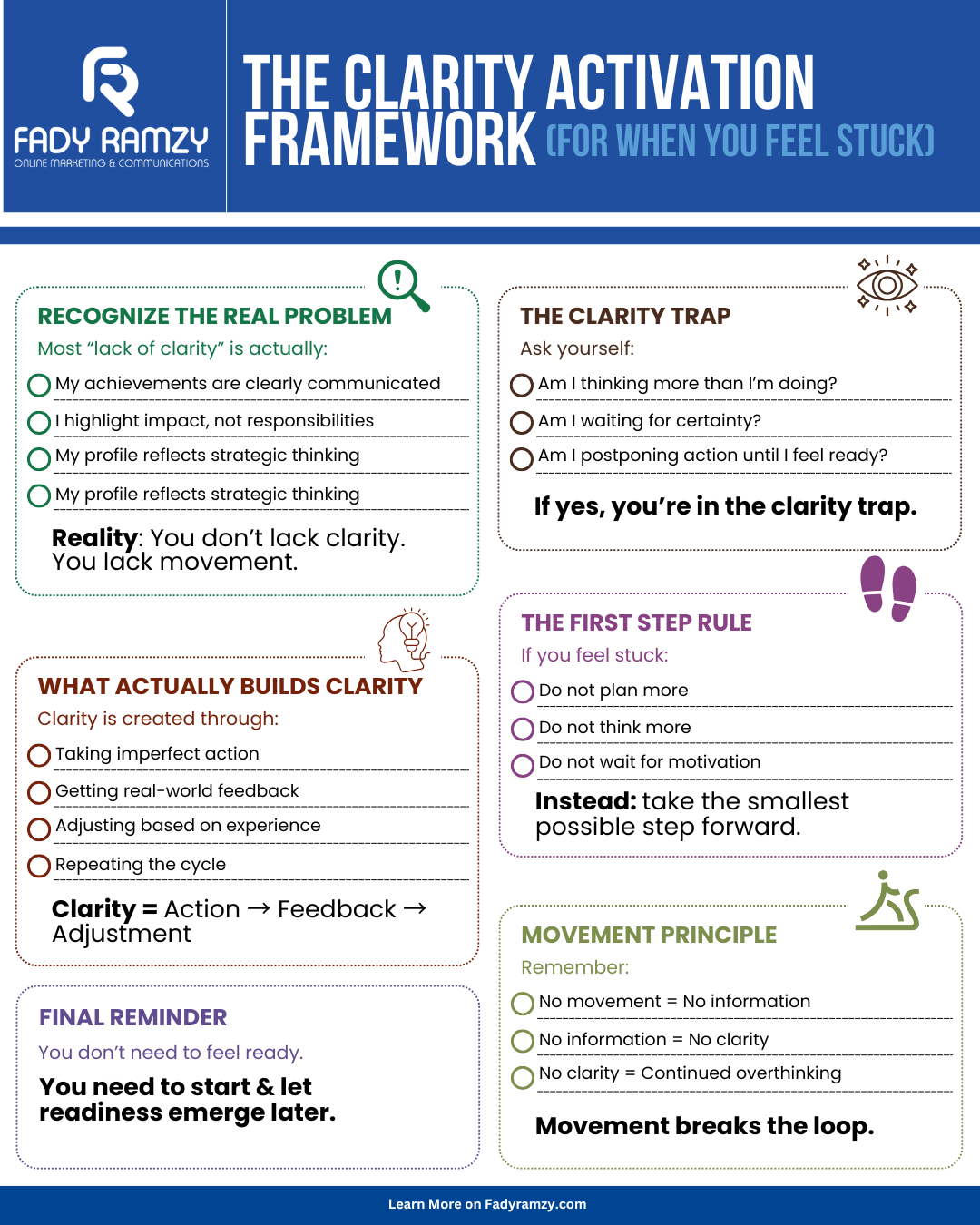
Movement Before Meaning
Clarity, positioning, and visibility are not static achievements.
They are dynamic outcomes shaped through movement.
Waiting for complete clarity often results in prolonged hesitation. But starting with partial clarity creates momentum, and momentum produces refinement.
In uncertain times, the advantage does not go to those who think the most.
It goes to those who move first, learn quickly, and adjust continuously.
Final Thought
You do not need to fully understand your path before you begin. You just need to begin in order to understand your path, and find your professional clarity in times of uncertainty.
If you are a CEO or senior leader ready to turn LinkedIn into your most powerful stage for influence, join my LinkedIn Influence Accelerator or book a private consultation. Together, we’ll craft your strategy, sharpen your message, and make your leadership visible.
Are You Moving or Waiting to Be Seen?
In uncertain times, professional clarity does not come from standing still. It comes from taking action, testing your positioning, and learning what is working.
But before you move forward, do you know how visible and clearly positioned you are today?
Take the Executive Visibility Assessment to discover your current visibility score and identify the areas that may be holding your professional presence back.
Don’t wait for clarity to find you. Start by measuring where you stand.

FAQ: Let’s Recap!
Q1: What does professional clarity mean?
A: Professional clarity is the state of knowing your direction, identity, and value in the market clearly enough to take purposeful action. It is not about having every answer. It is about having enough direction to move forward and refine as you go.
Q2: How do you find clarity in your career when you feel stuck?
A: Clarity rarely comes from thinking alone. It emerges through action. Even small, imperfect steps create feedback – what works, what does not, what feels aligned. That feedback loop is what gradually dissolves uncertainty and reveals a clearer path forward.
Q3: What is the difference between professional clarity and professional positioning?
A: Clarity is internal – it is knowing who you are and where you are going. Positioning is external – it is how that identity is communicated and perceived by others in your market. Both are necessary. Clarity without positioning leaves you invisible. Positioning without clarity feels hollow and inconsistent.
Q4: How do professionals transition from corporate to independent work?
A: The transition works best when approached as a phase of recalibration rather than an immediate reinvention. Start with directional intention – a clear enough sense of where you want to go to take the first step. Build visibility gradually through content, relationships, and consistent positioning. Clarity deepens as you move.
Q5: Why do high-performing professionals feel stuck despite strong track records?
A: Because visibility and capability are not the same thing. Many experienced professionals have strong track records but have never translated that experience into clear, external positioning. In a market where perception shapes opportunity, being capable but invisible is a real and common challenge.