The Executive Personal Brand Audit for 2026: From Content to Capital | An Effective Guide
What are the key points of an executive personal brand audit?
There was a time when your professional reputation lived primarily offline, but those days are long gone. Today it isn’t even enough to just have your CV reflected onto LinkedIn… Even for executives. Your big, fancy title needs an “Executive Personal Brand Audit for 2026”.
Back in the day, your reputation was built in meeting rooms, shaped through conversations, and reinforced by the people who had worked with you directly. Your CV acted as a summary of that reputation: a document that captured your experience and allowed others to interpret your value.
And for a long time, that was enough. Today, it isn’t.
The way professionals are discovered, evaluated, and selected has fundamentally changed. LinkedIn is no longer just a place to document your career; it has become a primary layer of professional visibility.
Your profile, your activity, and even your absence are constantly being interpreted, not only by people, but increasingly by systems.
Search engines index you. Platforms surface you. AI tools summarize you. And none of them “figure you out”, they just reflect what is clearly visible. While that may sound unfortunate, there is a solution to it: an Executive Personal Brand Audit.
Many executives assume that their experience will carry through, that their track record will naturally translate into opportunity. But in a visibility-driven environment, experience does not speak for itself, but rather it needs to be understood quickly, clearly, and in the right context.
Otherwise, it remains invisible.
The Visibility Economy
We are now operating in what can best be described as a visibility economy.
In this environment, value alone is not enough. What matters is how effectively that value is communicated and how easily it can be recognized. For example, two professionals can have comparable experience, similar achievements, and even similar capabilities, yet one will consistently attract more opportunities.
The difference is rarely competence. It is clarity.
The one who is easier to understand, easier to position, and easier to remember will always have an advantage. Again, it is not because they are more qualified, but because they are more visible in a meaningful way.
This is where many executives encounter friction. They sense that something is missing, but they misdiagnose the problem because the common response is to become more active: to post more, to share more, to “show up” more frequently. While that does seem logical because literal visibility does come from activity, however activity without direction rarely produces results.
Content: The 1st Pillar of the Executive Personal Brand Audit
Content, in isolation, is not a strategy. It is simply an output. And if that output does not shape how others perceive your expertise, your perspective, and your relevance, then it does not change your positioning. It only increases noise.
This is why many professionals find themselves in a frustrating loop. They are visible, but not recognized. Active, but not considered. Present, but not understood.
The issue is not the presence of content. It is the absence of structure behind it. To understand what actually drives visibility today, it helps to move away from thinking about content altogether and focus instead on capital.
Capital: The 2nd Pillar of the Executive Personal Brand Audit
Your personal brand is not defined by how much you post.
Rather, it is defined by the signals you build over time, such as signals that shape how the market evaluates you. These signals accumulate into different forms of capital, and together they determine how you are perceived.
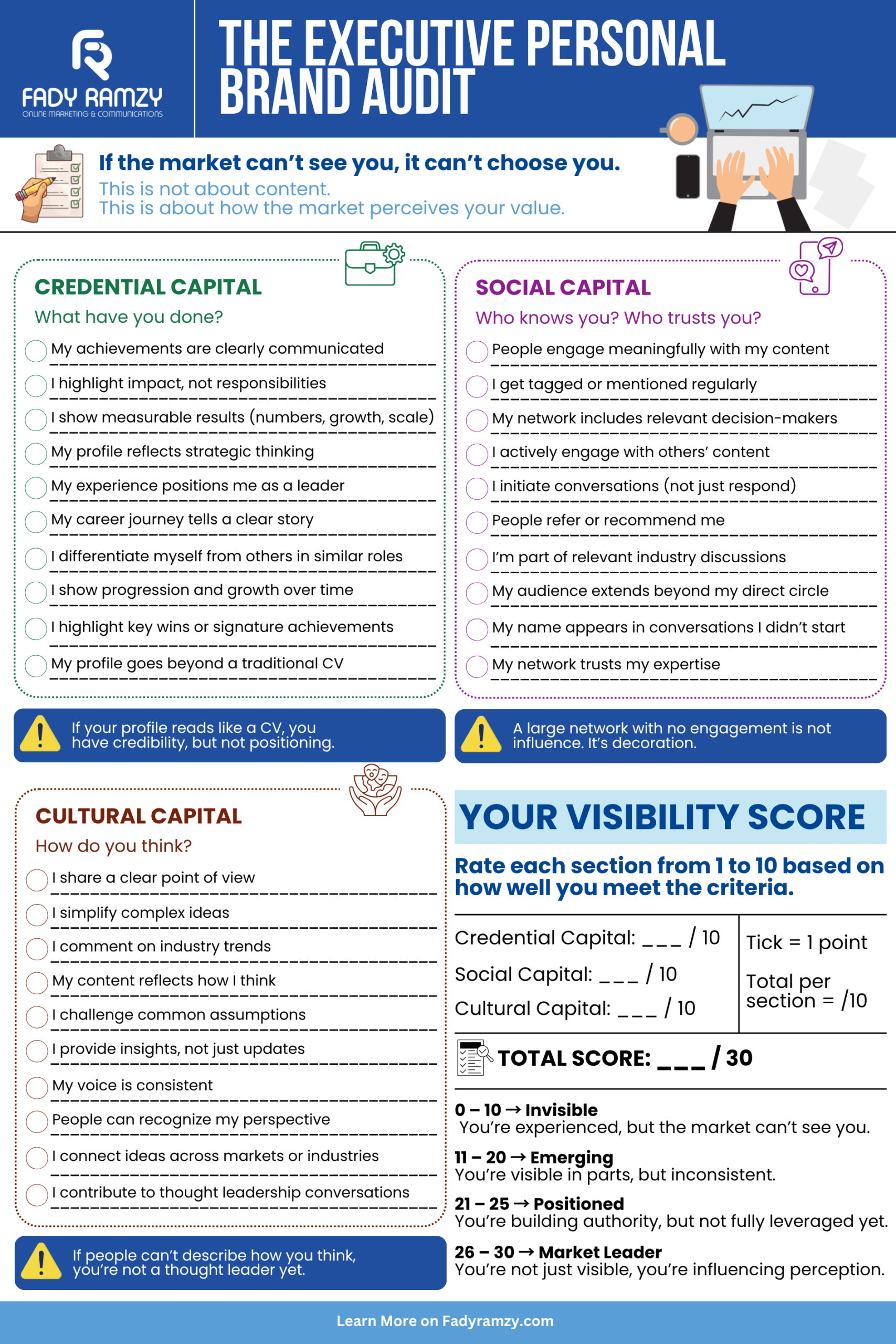
The First is Credential Capital.
This is the most familiar: your track record. The roles you’ve held, the results you’ve delivered, the experience you’ve accumulated over the years. This is the foundation of your credibility, and for most executives, it is well established. But while it answers the question of what you’ve done, it does little to explain what that means in a broader context. It tells a story, but often an incomplete one.
The Second is Social Capital.
The second form of capital is relational. It exists in how others experience you; through your network, your reputation, and your presence in conversations. It’s reflected in whether your name comes up when relevant topics are discussed, whether people refer to you, and whether your ideas resonate enough to be engaged with. This is not about the size of your network, but about its depth and responsiveness. It determines whether your credibility stays static or begins to move.
The Third is Cultural Capital.
The third form of capital is where true differentiation happens. It lies in how you think. Your perspective, your ability to interpret what’s happening in your industry, and the clarity with which you can express that interpretation. In a landscape where information is widely accessible, what sets people apart is no longer what they know, but how they make sense of what they know. This is the layer that turns experience into authority and familiarity into recognition.
The Biggest Executive Mistake
Most executives build the first form of capital over years, sometimes decades. The second develops gradually through relationships and exposure. The third, however, is rarely built intentionally. And yet, it is the one that most directly shapes perception.
This imbalance leads to the most common mistake in executive positioning: over-reliance on experience.
There is an assumption that if the track record is strong enough, it will naturally lead to visibility. Often, they expect the right people to notice, the right opportunities to surface, and the market to connect the dots.
But the market doesn’t connect the dots.
It responds to what is clear. Because, let’s be real: the market is busy, saturated and drowning in information overload. So, this is why “standing out” online is key.
If your achievements are not contextualized, they become a list. If your perspective is not visible, your thinking remains unknown. If your presence in conversations is limited, your relevance becomes easy to overlook.
None of this reflects a lack of capability. It reflects a lack of translation.
This is where a structured audit becomes essential.
The Executive Personal Brand Audit
To close this gap, you need more than activity.
You need clarity.
This is where the Executive Personal Brand Audit comes in.
At its core, the audit is a simple but powerful exercise:
Evaluate yourself across the three forms of capital.
- How clearly are your achievements communicated?
- How strong is your presence within your network?
- How visible is your thinking and perspective?
This is not as a theoretical exercise, but as a way to confront how you actually appear in the market today.
Most professionals don’t struggle to answer these questions but what they struggle with is what those answers imply. Because the gaps, once seen, are difficult to ignore.
The Future: AI, Search, and Digital Positioning
What makes this even more relevant in 2026 is the growing role of AI in shaping professional visibility.
It is no longer hypothetical to ask how you are represented by systems, because it is already happening. People search for names, ask questions, and rely on generated summaries to form initial impressions. And these systems don’t evaluate potential or nuance, but instead they rely on available signals.
Which makes for a simple but powerful test.
If you dare….Ask an AI tool to describe you.
What it produces is not just a summary of your experience. It is a reflection of your positioning. If the answer lacks clarity, depth, or distinction, it is not a limitation of the system, however, it is an indication of what the system can see.And what it can’t.
Strategic Visibility is the Answer to the Executive Personal Brand Audit
All of this leads to a broader conclusion.
We are no longer operating in a system where experience alone drives opportunity. We are operating in one where visibility shapes access, and positioning influences outcomes.
This doesn’t reduce the importance of experience, but rather it raises the standard for how that experience needs to be communicated. Because ultimately, the market does not reward the most experienced professional. It rewards the one it can understand the fastest, trust the most, and remember the longest.
If you want to explore this more deeply, including how to identify your specific gaps and strengthen each layer of your positioning, you can continue reading the full breakdown here:
Ready to get visible?
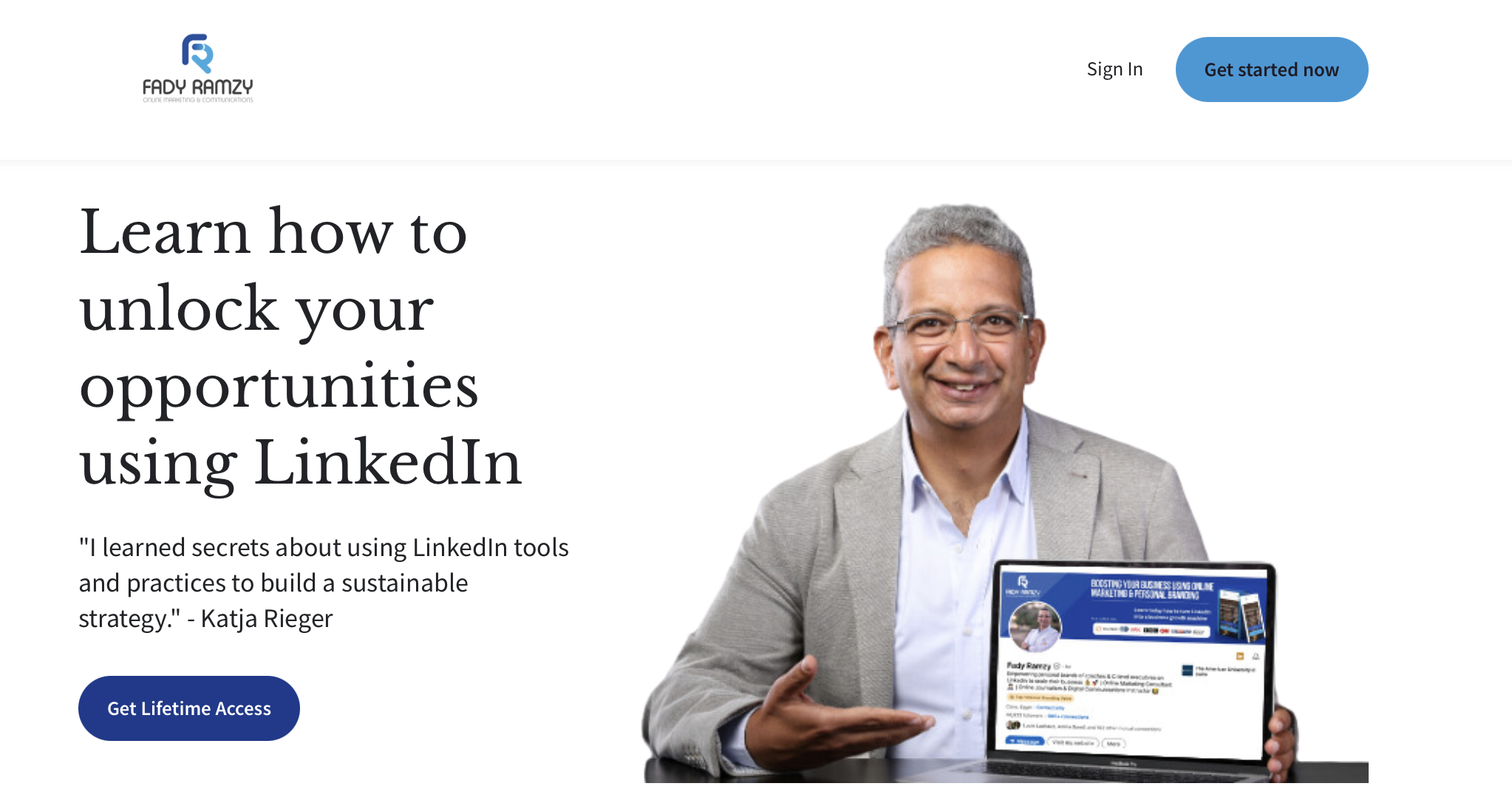
If you are a CEO or senior leader ready to turn LinkedIn into your most powerful stage for influence, join my LinkedIn Influence Accelerator or book a private consultation. Together, we’ll craft your strategy, sharpen your message, and make your leadership visible.
FAQ: Let’s Review!
Q1: What is an executive personal brand audit?
A1: An executive personal brand audit is a structured review of how you appear in the professional market across three key areas: your credential capital (track record and achievements), your social capital (network presence and reputation), and your cultural capital (how clearly your thinking and perspective are visible). The goal is to identify gaps between the experience you have built and how effectively that experience is being communicated and recognized online.
Q2: Why do executives need a personal brand audit in 2026?
A2: In 2026, professional visibility has moved far beyond the CV. Search engines index you, platforms surface you, and AI tools summarise you based on the signals you put out. Executives who rely solely on their track record often find themselves invisible in a visibility-driven economy – not because they lack capability, but because their experience has not been translated into clear, recognizable positioning. A personal brand audit helps close that gap.
Q3: What is the difference between content and capital in personal branding?
A3: Content is an output – posts, articles, and activity on platforms like LinkedIn. Capital is the accumulated signal that shapes how the market perceives you over time. Content without a strategy only adds noise. Capital – built through clear credentials, strong relationships, and a visible perspective – is what actually drives opportunity. The most effective executive personal brands focus on building capital, not just producing content.
Q4: How does AI affect executive personal branding?
A4: AI tools are increasingly being used to search for, summarise, and evaluate professionals before any human interaction takes place. When someone asks an AI tool to describe you, the output reflects your current positioning – not your potential. If the summary lacks clarity, depth, or distinction, it is a signal that your digital presence needs strengthening. Executives who invest in strategic visibility are better represented by these systems and make stronger first impressions before a conversation even begins.
Q5: How do I start an executive personal brand audit?
A5: Start by evaluating yourself honestly across three questions: How clearly are your achievements communicated in the market? How strong and active is your presence within your professional network? And how visible is your thinking and perspective to people outside your immediate circle? Once you identify the gaps, you can begin building the missing layer – whether that is clarifying your credentials, deepening your network presence, or developing a consistent point of view that reflects your expertise.