5 Transformative Steps to Build a Board-Ready LinkedIn Profile That Drives Visibility
Explore how a board-ready LinkedIn profile can help executives communicate expertise, strengthen credibility, and attract board opportunities
A board-ready LinkedIn profile is essential if you aspire to join a corporate board. More than a digital résumé, it becomes your boardroom calling card and signals authority, credibility, and readiness.
During a workshop with Women for Boards GCC Founder Katja Reiger, participants explored how to transform their LinkedIn presence into a strategic visibility tool that supports their board ambitions.
The conversation quickly moved beyond profile optimization. It became clear that visibility is not simply about being active online. It is about ensuring that your expertise, values, and leadership experience can be discovered by the right people at the right time.
For executives seeking board positions, a LinkedIn profile should not only describe what they have achieved. It should communicate who they are as leaders, what perspectives they bring, and why they should be considered for future opportunities.
A strong board candidate LinkedIn profile combines credibility, clarity, and visibility. It starts with a clear positioning strategy, including a strong LinkedIn headline for board roles, a leadership narrative, and consistent engagement that demonstrates expertise.
During the workshop, participants worked on refining their profiles and taglines to ensure that when someone visits their page, they immediately see a decision maker rather than only an executor.
A key insight emerged: board opportunities are often built long before a position becomes available. If people cannot understand your expertise, values, and leadership contribution online, they may never think of you when an opportunity arises.
This led the conversation from profile optimization to influence architecture: how your LinkedIn presence can become a long term asset that supports board readiness.
5 Steps to Build a Board-Ready LinkedIn Profile
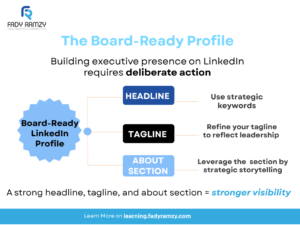
Building executive presence on LinkedIn requires deliberate action.
The first step is using strategic keywords in your LinkedIn headline for board roles. This is not about simply listing your current position. It is about helping others understand your expertise, leadership experience, and areas where you can contribute.
For example:
Less effective:
Chief Operating Officer at XYZ Company
Stronger:
Chief Operating Officer | Strategy | Governance | Business Transformation | Board Advisor
The stronger headline immediately tells visitors what you are known for and improves your profile’s discoverability in LinkedIn searches.
The second step is refining your tagline. During the workshop, participants explored how a tagline should reflect their leadership identity and future ambitions rather than only their current role.
For example:
Less effective:
Senior executive with over 20 years of experience.
Stronger:
Helping organizations strengthen governance, drive sustainable growth, and lead strategic transformation.
A strong tagline gives readers an immediate sense of your leadership style and the impact you create.
The third step is using the About section as a leadership narrative. It should communicate your journey, experience, achievements, and the perspective you bring as a leader.
For example, rather than writing:
“Responsible for managing regional operations across five countries.”
You could write:
“Over the past decade, I’ve led business transformation across five markets, helping organizations strengthen governance, build high-performing leadership teams, and navigate periods of rapid growth.”
The second version gives readers a much clearer picture of your leadership journey and executive perspective.
The fourth step is showcasing expertise through content and engagement. Sharing insights, commenting on relevant discussions, and participating in professional conversations help build credibility over time.
Strategic commenting was highlighted as a particularly valuable visibility tool because it allows executives to demonstrate how they think and contribute to important conversations.
However, the discussion also emphasized that visibility requires judgment. One participant highlighted that commenting directly on sensitive topics can have “downsides.”
Executives need to be thoughtful about what they share, the conversations they join, and the values they want their online presence to represent.
The fifth step is aligning your profile with the industries, organizations, and conversations where you want to be recognized.
Visibility is not about being everywhere. It is about being intentional about where and how you show up.
As explained in this guide on transitioning executive profiles to board authority, these deliberate steps build credibility and visibility simultaneously.
What Is Influence Architecture for a Board-Ready LinkedIn Profile?
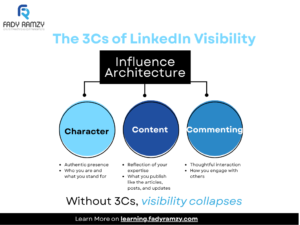
Influence architecture is the deliberate design of your online presence to shape perception and strengthen professional credibility through your board-ready LinkedIn profile.
It rests on the 3Cs framework: character, content, and commenting.
Character represents who you are and what you stand for. Content demonstrates your expertise and perspectives. Commenting helps you participate in conversations and build meaningful connections.
The workshop highlighted that visibility requires balance. A strong online presence can create opportunities, but executives must also understand the long term impact of what they share.
As one participant emphasized, online presence “never goes away.” Even deleted content can continue to exist, making thoughtful engagement essential.
At the same time, being overly cautious can create another challenge. As discussed during the session, “extreme caution might just make us invisible.”
The goal is not to avoid visibility. It is to build a professional presence that reflects your expertise while protecting your reputation.
This echoes the principles outlined in the triangle of first impressions, where the way you present yourself online directly shapes how others perceive your authority.
Personal Brand vs Professional Reputation: What’s The Difference?
A personal brand is the story you intentionally communicate about yourself online. It reflects how you want to be known and the expertise you want associated with your name.
Professional reputation is what others believe about you based on your experience, actions, and track record.
Both matter.
A strong board candidate LinkedIn profile connects the two by showing achievements while reinforcing the leadership qualities boards seek.
During the workshop, participants discussed how even highly qualified professionals may struggle to access opportunities if their expertise is difficult to discover online.
One important observation was that professionals without online visibility risk becoming difficult to evaluate. Even when people believe someone is qualified, they often search online before considering them for opportunities.
For board positions, people want to understand who they are inviting into the room.
Optimizing LinkedIn for AI Discovery
One of the practical takeaways was the growing importance of optimizing LinkedIn for AI-driven discovery.
Adding relevant keywords and board-related language helps algorithms understand your profile and increases the likelihood that you appear in relevant searches.
However, optimization is not about creating a profile for machines. It is about making sure your online presence accurately reflects the expertise, leadership, and values you already have.
A useful exercise is to view yourself from the perspective of someone searching for you for the first time.
What happens when they type your name into Google?
What appears when someone who does not know you looks at your LinkedIn profile?
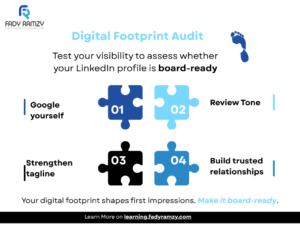
Testing your visibility through a fresh search, a different device, or even a separate AI tool can provide a more realistic picture of your digital footprint.
How to Transfer Board Experience to the Private Sector
Many participants asked how governance experience can become relevant for corporate boards.
The discussion highlighted that experience gained in one market does not always automatically translate into opportunities in another. Building relationships, communicating expertise, and increasing visibility are essential parts of entering new board ecosystems.
The conversation also touched on the challenges some professionals face when trying to access board opportunities, particularly women entering environments where representation at board tables remains limited.
Visibility becomes an important tool to ensure qualified leaders are seen and considered.
Your expertise cannot create opportunities if nobody knows it exists.
Visibility is not optional. As explained in this article on overcoming the fear of posting, your personal brand is your greatest career asset. Building visibility on platforms like LinkedIn is essential for attracting opportunities.
Your expertise cannot create opportunities if nobody knows it exists.
Treat Visibility as a Game of Time
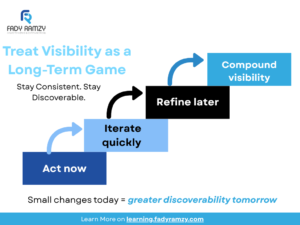
Another key theme was that visibility is built gradually.
It is not a one-time activity or a quick profile update. It is a long-term investment where small actions compound over time.
Participants were encouraged to start with practical steps: improving headlines, learning from strong profiles, adapting ideas to their own voice, and seeking feedback.
The goal is not perfection.The goal is progress and consistency.
Iteration is key. Make a change, observe the impact, and continue refining. Maintain a human tone, stay open to feedback, and use peer learning to accelerate improvement.
Your personal brand and digital footprint are assets. The question is whether they are working for you or against you.
Collaborative review speeds improvement and learning. As emphasized in this perspective on visibility as a long-term game, perfection is a trap that wastes time since progress comes from consistent action.
Test Your LinkedIn Visibility
One of the most practical ways to understand your current online presence is to test how others find you. Search your name on Google, check LinkedIn from different devices, and see what appears. This gives you a clear picture of how visible you are today.
To go deeper, you can take the Executive Visibility Assessment. It’s a quick, structured tool that highlights your strengths and areas for improvement, helping you identify whether your LinkedIn profile is truly board-ready. The results provide actionable insights you can use immediately to refine your headline, About section, and overall digital footprint.
By combining the above-mentioned strategies , from refining taglines to applying the 3C framework , with the personalized feedback from the assessment, you’ll have a clear roadmap to strengthen your board-ready LinkedIn profile and position yourself for board opportunities.
Act Now , Not Later
Board readiness is not about waiting until the perfect opportunity appears.
It is about preparing before the opportunity exists.
Your online visibility is a critical part of being selected, elected, or invited to join a board. For current board members, demonstrating your expertise online can create the next opportunity and expand your professional influence .
Your board-ready LinkedIn profile is more than a career summary. It is your digital reputation, your leadership platform, and a reflection of the value you bring to the boardroom.
Build it intentionally. Refine it continuously. Let it work for you.
Frequently Asked Questions (FAQ): Let’s make your LinkedIn profile truly board‑ready
Q1-Should my LinkedIn headline mention “board roles”?
Yes. If you are seeking board opportunities, your headline should communicate your board ambition, expertise, and governance experience.
Q2-How often should I post on LinkedIn?
Consistency matters more than frequency. Visibility grows through regular actions such as posting, commenting, and engaging in relevant conversations.
Q3-Is commenting as valuable as posting?
Yes. Strategic commenting helps demonstrate expertise, contribute to discussions, and make your thinking visible.
Q4-How do I make board experience relevant?
Highlight transferable governance skills, strategic expertise, and leadership experience so others understand the value you bring.
Q5-How do I know if my board-ready LinkedIn profile is discoverable?
Search your name online from the perspective of someone who does not know you. Review whether your profile reflects the expertise and leadership identity you want to communicate.
Q6-Should I ask someone to review my profile?
Yes. A fresh perspective can identify gaps and help ensure your profile communicates the right message for board opportunities.